If you are choosing between Seedream 5.0 and Nano Banana 2 AI on UGC Maker AI, the real question is not which model sounds more advanced. It is which one fits the kind of creative work you actually need to finish.
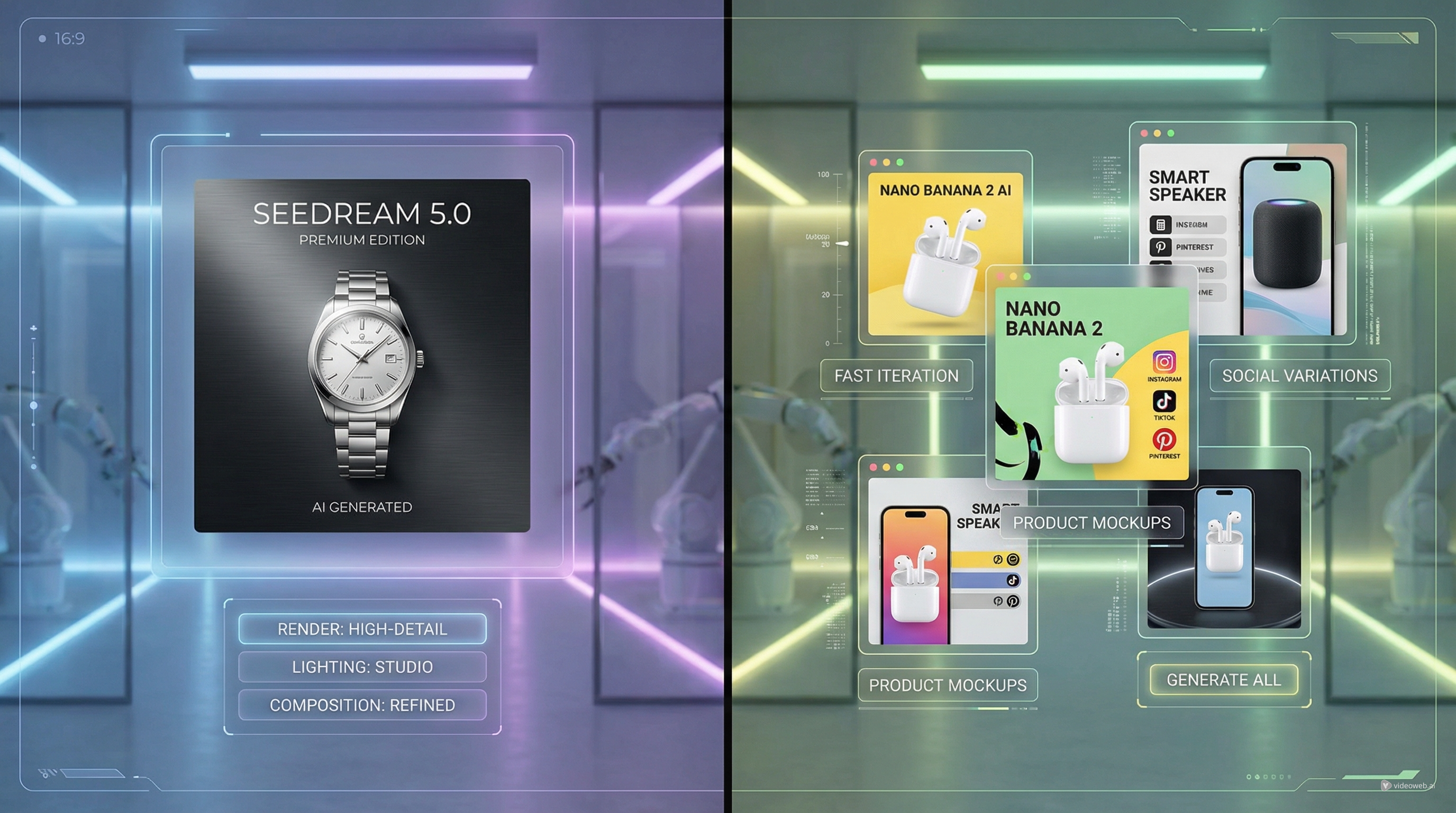
Both models sit inside UGC Maker’s broader ad-creative ecosystem, but they feel different in practice. Seedream 5.0 is positioned as a high-resolution image model with strong text rendering, natural-language editing, and an all-in-one generation-plus-editing workflow. Google Nano Banana 2 is positioned more around speed, strong prompt understanding, photorealistic output, and flexible commercial image creation.
That difference matters if you are building ad visuals, product images, social creative, or UGC-style assets at scale. Some creators need the cleaner layout handling and refined editing workflow associated with Seedream 5.0 Lite. Others care more about fast iteration, consistent characters, and the practical speed of generating images with Nano Banana 2.
What Seedream 5.0 is built for
UGC Maker presents Seedream 5.0 as a premium image generator for detailed prompts, higher-resolution output, and more advanced editing. The model page emphasizes high-resolution generation, natural-language editing, professional typography rendering, and native 2K/4K support. In other words, it is not just a basic text-to-image tool. It is meant to handle image creation and image refinement in one place.
That makes it appealing for users who care about structured layouts, poster-like compositions, product marketing visuals, and scenes where small details matter. If your prompt includes exact composition rules, strong semantic guidance, or text elements that need to render cleanly, Seedream 5.0 looks like the more design-forward choice.
The platform also surfaces the phrase Seedream 5.0 Lite, which suggests that users may encounter the model under both names in discussions and comparisons. For practical article writing, it makes sense to treat them as closely related search intents on the same UGC Maker model page.
What Nano Banana 2 AI is built for
UGC Maker positions Nano Banana 2 AI as a fast, multimodal image generation and editing model with strong real-world usefulness. Its model page describes it as a Gemini-based image model with Pro-grade quality, Flash-level speed, strong prompt understanding, precise text rendering, and multi-character consistency.
That combination makes Google Nano Banana 2 especially attractive for creators who do not want to overcomplicate the workflow. If your goal is to test ad concepts quickly, produce multiple visual angles, or move from idea to campaign draft without a slow creative loop, Nano Banana 2 AI has a very practical appeal.
This is also why generating images with Nano Banana 2 makes sense for social content, product promos, quick mockups, creator-style storytelling, and ad experimentation. It is the kind of model that fits fast-moving marketing work where speed and consistency matter almost as much as quality.
Seedream 5.0 vs Nano Banana 2 AI: the real workflow difference
At a high level, Seedream 5.0 looks stronger when your work needs cleaner design control, more advanced editing, and better handling of detailed compositions. Nano Banana 2 AI looks stronger when your priority is faster generation, reliable commercial-style output, and easier iteration across many ideas.
Here is the simplest way to think about it:
| Category | Seedream 5.0 | Nano Banana 2 AI |
|---|---|---|
| Best fit | Design-heavy image creation and editing | Fast commercial image generation and editing |
| Resolution emphasis | Strong, with native 2K/4K positioning | Strong quality, but speed is the bigger pitch |
| Editing style | Natural-language edits with refined control | Fast modifications and practical prompt responsiveness |
| Layout and typography | A clear strength | Good, but not the main identity |
| Prompt complexity | Well suited for detailed instructions | Strong for everyday complex prompts |
| Iteration speed | Balanced | One of its biggest selling points |
| Marketing use | Strong for polished assets | Strong for fast ad-ready output |
| Creator workflow | Best for refinement and control | Best for speed and flexible testing |
So the choice is less about which model is universally better and more about which friction you are trying to remove.
Which model should you choose?
Choose Seedream 5.0 if you care about high-resolution output, structured compositions, cleaner text rendering, and edits that need to follow precise instructions. It is the better pick when the image itself needs to feel polished before it ever becomes part of a wider campaign.
Choose Seedream 5.0 Lite if your workflow centers on poster-like layouts, brand graphics, or visual assets that need a more controlled design feel without bouncing into separate editing software.
Choose Nano Banana 2 AI if you care about speed, strong prompt understanding, and practical image creation for marketing, ad testing, and social content. It feels especially useful when you want to create several directions quickly and then keep iterating.
Choose Google Nano Banana 2 if your team values rapid output, realistic commercial visuals, and reliable consistency in everyday creator workflows.
And if your main question is whether generating images with Nano Banana 2 is enough for campaign work, the answer is yes for many fast-moving use cases. It may not replace every design-first workflow, but it looks very well suited to ad-ready image production.
How these models fit into UGC Maker AI
The bigger reason this comparison matters is that UGC Maker is not just a single-model playground. The platform is built around AI ad creation for brands, marketers, and creators. Its main site highlights image generation, UGC image creation, UGC ads generation, and a growing set of AI models including Seedream 5.0, Nano Banana 2 AI, Seedance 1.5, Seedance 2.0, and Kling 3.0.
That means you can treat this comparison as one step in a larger workflow. For example, you could:
- Build polished visuals with Seedream 5.0 when layout, typography, or editing precision matters.
- Use Nano Banana 2 AI for rapid concept expansion, alternate image directions, and faster ad iterations.
- Move the strongest visuals into UGC-focused tools for product marketing, lifestyle mockups, or ad production.
- Extend the campaign into motion using UGC Maker’s video-oriented tools and models.
That is ultimately what makes the comparison useful. You are not just picking a model in isolation. You are choosing where to begin inside a broader creative system.
Final verdict
If you want the cleaner, more design-sensitive option, Seedream 5.0 is the stronger choice. If you want the faster, more flexible, and more iteration-friendly option, Nano Banana 2 AI is likely the smarter pick.
For many creators, the best answer will not be choosing only one. It will be using Seedream 5.0 when precision matters, then using Google Nano Banana 2 when production speed matters more.
Other Tools and Models to Recommend
- AI Image Generator for broader text-to-image and image-editing workflows on the same platform.
- UGC Image Generator for turning products into more natural lifestyle-style marketing visuals.
- UGC Ads Generator for moving from static images into ad-focused creative assets.
- Seedance 2.0 if you want to extend still-image workflows into AI video creation.
- Kling 3.0 for UGC-style video experiments and ad-ready motion content.
Related Articles
- Nano Banana 2 on UGC Maker: Best Scenes, Prompt Ideas, and How to Use It
- UGC Image Generator User Guide: How to Create Better UGC-Style Product Visuals Faster
- How to Use Seedance 2 to Create AI UGC Ads That Actually Feel Native
- Kling 3.0 UGC Video Generation Guide (UGC Maker AI)
- How to Make UGC Images in Minutes with UGC Maker (2026 Guide)
People Also Read
- Nano Banana 2 vs Qwen Image 2.0 vs Seedream 5.0: Which HeyDream Model Fits Your Workflow?
- HeyDream AI Image Generator Guide: Best Models for Text-to-Image and Image-to-Image
- Nano Banana 2 vs Nano Banana Pro: What Changed and Which One Fits Your Workflow?
- How to Use Nano Banana 2 for AI Image Generation and Editing
- Nano Banana 2 vs Seedream 5.0: A Practical Comparison Guide
- The Seedream 5.0 AI Image-to-Image Analysis Guide 2026