If you’ve been following AI video lately, you’ve probably seen one name pop up everywhere: Happy Horse AI. The reason is simple. It arrived with real momentum, quickly got people talking, and started being treated as one of the most interesting new video models for short-form creative work.
For creators and marketers, though, the real question is not whether the model is trending. The real question is: can it actually help you make better UGC ads and better short videos?
The answer is yes—but only if you use it with the right mindset.
A lot of people still approach AI video like a magic trick. They type a broad idea, hope for a miracle, and then wonder why the result looks impressive for two seconds but unusable as an ad. UGC-style content works differently. It wins because it feels native, direct, and believable. That means your prompt needs to think like a creator, not like a movie trailer.
That is where a practical workflow matters.
Why HappyHorse matters right now
What makes HappyHorse interesting is not just hype. It entered the conversation as a strong new video model at a time when creators are actively looking for better motion, better prompt-following, and more ad-ready outputs. In other words, it showed up when the market actually needed it.
That matters for short-form advertising because UGC ads live or die on clarity. You need a clean hook, a believable product moment, and a payoff that feels fast enough for TikTok, Reels, or Shorts. If a model gives you better motion but still makes the product unclear, that does not help much. If it gives you cinematic beauty but not a native social feel, that also misses the point.
The better way to think about Happy Horse AI-style UGC ads is this: use the trend as a creative advantage, but build the video around a proven ad structure.
The best use cases for creator-style video
Not every product needs the same kind of clip. In practice, there are three formats that work especially well.
The first is the product-first ad. This works best when the item itself is visually appealing: skincare, drinks, gadgets, packaging, fashion, or desk products. The camera stays close to the product, and the story is really about texture, use, and immediate appeal.
The second is the creator-first short. This is where a talking-head format becomes useful. A realistic avatar or spokesperson can deliver the hook, explain the product in plain language, and make the content feel more like a recommendation than a commercial. That is where HappyHorse 1.0 becomes especially relevant in a practical workflow, because the value is not just motion—it is how well the final short supports a human delivery style.
The third is the hybrid format. This is often the strongest option for performance marketing. Start with a face, switch to product proof, then end with a quick CTA. It feels social first, but still gives the product enough screen time to sell.
How to actually build a usable short
The easiest way to waste credits is to start with a vague idea like “make a cool ad for my product.” That usually produces something generic.
A better workflow starts with one angle only.
Ask yourself: what is the one thing this short needs to communicate? Is it convenience? A premium look? A satisfying texture? A transformation? A time-saving benefit? Pick one.
Then choose your format. Is this supposed to feel like a testimonial, an unboxing, a mini-demo, a before-and-after clip, or a founder-style pitch? Once that is clear, the prompt becomes much easier.
Next, decide who leads the frame. If the product is visually strong, let the product lead. If trust and explanation matter more, let the person lead.
From there, treat the tool less like a toy and more like an AI video generator for testing ad concepts. That means you do not generate one clip and stop. You generate multiple variations with the same core angle, then compare which one has the strongest first three seconds.
That is exactly how real short-form ad iteration works.
What makes a UGC prompt work
The strongest prompts usually answer a few basic questions clearly.
What is the subject? What is the product? Where is the scene happening? How is it filmed? What is the main action? What should the viewer feel? What proof point should stand out?
When people overcomplicate prompting, they often add too many style words and not enough useful direction. UGC content is usually better when it feels grounded. A bathroom counter, a kitchen table, a desk setup, a streetwear mirror shot, a quick car selfie—these are familiar environments, and familiarity is part of what makes the video believable.
That is why a Happy Horse AI workflow should usually stay simple. One shot idea. One main action. One emotional payoff.
Instead of asking for “a stunning cinematic masterpiece,” ask for a vertical selfie-style skincare review in soft daylight, with a close-up of the product texture and a quick authentic reaction. That is much easier for the system to turn into a usable short.
A practical mindset for UGC ads
There is also a creative mistake people make with AI ads: they chase perfection instead of performance.
But high-performing UGC is not always polished. In fact, it often works because it feels slightly raw, fast, and native to the feed. The goal is not to make the viewer think, “What an incredible VFX showcase.” The goal is to make them think, “That looks useful,” or “That actually feels like something I would try.”
This is also why HappyHorse 1.0 creator-style video workflows make more sense when paired with a system built for ad use, not just raw experimentation. You want a short path from idea to usable output.
For many teams, the practical route is to use Happy Horse AI-inspired ad generation for product-led visuals and pair it with a talking-head or spokesperson flow when the script needs more trust, explanation, or creator energy.
What to expect in real use
It helps to stay realistic. A trending model can still produce misses. Some generations will feel too polished. Others may lose packaging accuracy or drift away from the product’s actual shape. And some clips may look impressive but still fail as ads because the hook is weak.
So the smart workflow is not “generate once and publish.” It is:
Start with one clear angle. Generate a few variations. Keep the one with the strongest opening. Rewrite the weak part. Run another pass.
That is the difference between random AI video output and an actual creative system.
In that sense, the latest buzz around HappyHorse is useful—but the bigger lesson is even more practical. Great UGC ads do not come from hype alone. They come from matching the right model to the right format, writing prompts that think like a creator, and iterating until the video feels native to the platform.
If you do that well, the model is not just a trend. It becomes a shortcut to faster testing, more ideas, and stronger short-form ad production.
Detailed Prompt Ideas
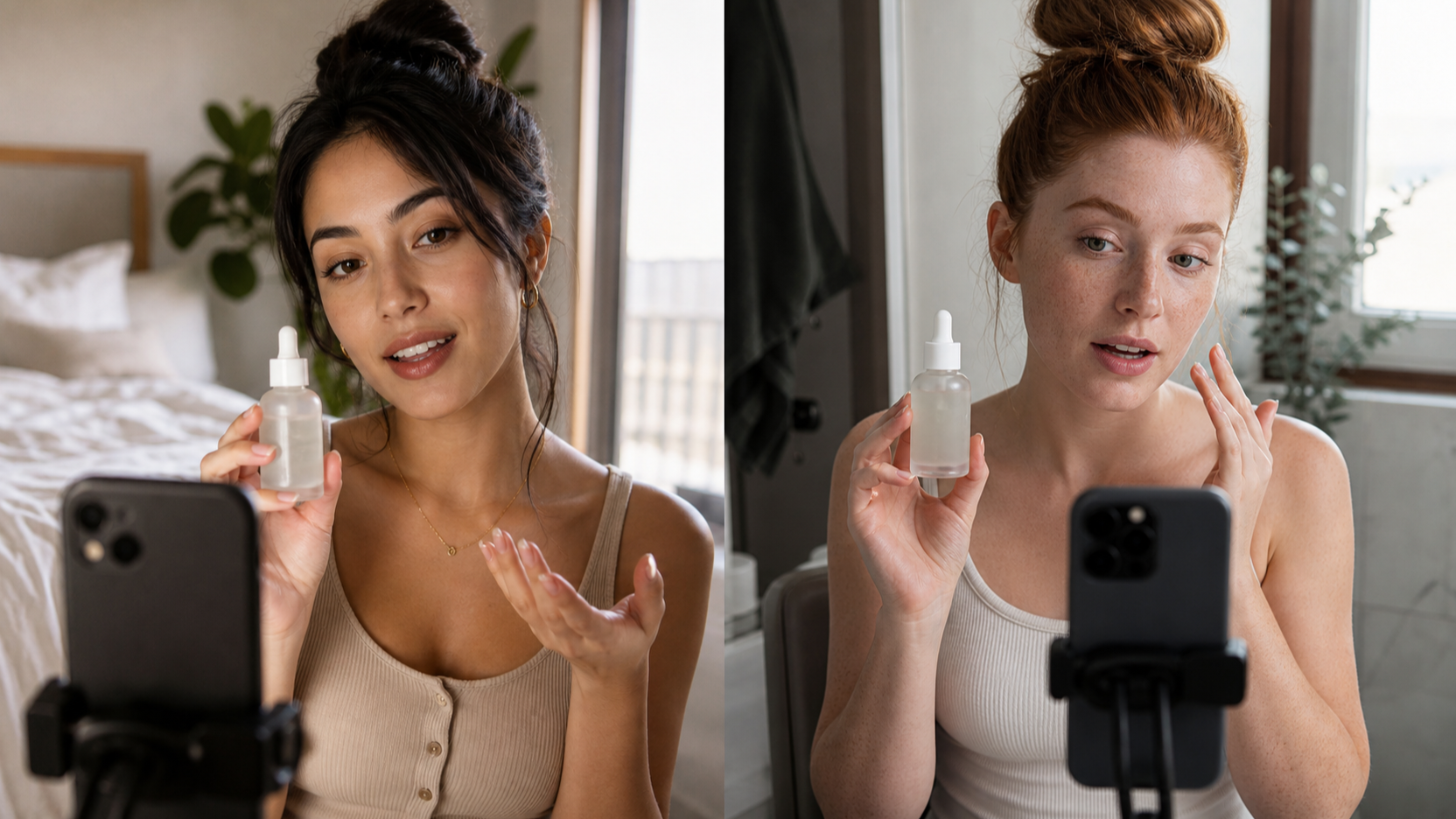
Prompt 1: Skincare UGC short
“Vertical UGC ad, selfie-style bathroom video, creator holding the exact skincare bottle from the reference image, casual and trustworthy tone, says this became her 2-minute morning routine, close-up of product texture on fingertips, quick cut to applying on cheek, soft daylight, realistic handheld movement, clean sink background, native social video energy, end with a simple product hero shot, no warped bottle, no label changes, no extra hands.”
Prompt 2: Beverage ad short
“Vertical creator-style short, cozy morning kitchen, exact drink can from product image, creator opens fridge, grabs can, close-up of condensation, pours into glass with ice, takes first sip, genuine reaction, warm sunlight, fast social-style cuts, focus on refreshment and packaging clarity, realistic liquid motion, no distorted can branding, no floating objects.”
Prompt 3: App or SaaS promo
“UGC-style talking-head short, founder-like creator at home desk, explains one frustrating workflow problem and one simple fix, cutaways to laptop screen use, calm and useful tone, natural room lighting, realistic face motion, slight handheld camera feel, social-first pacing for Shorts and TikTok, end with subtle CTA, no fake UI glitches, no uncanny lip sync.”
Prompt 4: Fashion product short
“Mobile-first vertical fashion ad, streetwear creator holding the exact hoodie from reference image, quick hook with fabric close-up, cuts between trying it on, mirror shot, walking outdoors, natural urban lighting, casual confident energy, emphasize oversized fit and structure, realistic fabric motion, no color shift, no body distortion.”
Prompt 5: Home gadget demo
“Short UGC ad in a modern apartment kitchen, creator unboxes compact home gadget, shows setup in one smooth sequence, close-up on buttons and finish, demonstrates one clear benefit, practical voice and realistic reactions, soft daylight, clean composition, consumer-tech short-form ad style, end with tidy product hero shot and simple CTA, no random accessories, no brand drift.”
Recommended Tools
- UGC Maker AI
- UGC Ads Generator
- AI UGC Maker
- Seedance 2.0 on UGC Maker
- Kling 3.0 on UGC Maker
- Nano Banana 2 on UGC Maker
Related Article
- How to Make UGC Ad Videos With UGC Maker AI
- How to Use Seedance 2 for AI UGC Ads That Convert
- Kling 3.0 UGC Video Generation Guide
- Creatify AI UGC Ads Guide: A Comprehensive Step-by-Step Workflow (Plus the Alternative)
People Also Read
- How to Use the AI Music Video Generator: A Detailed Guide from Song to Video
- Seedance 2.0 vs 1.0: What’s Better for AI Video
- How to Use DreamMachine AI’s AI Video Generator: A Practical Guide for Text and Image Workflows
- Seedance 2.0 Video Generation Guide: Tutorial + Prompts
- The 2026 Image-to-Video Guide for Sea Imagine AI: Best Models & Prompts